Texas Urban Lizard Project
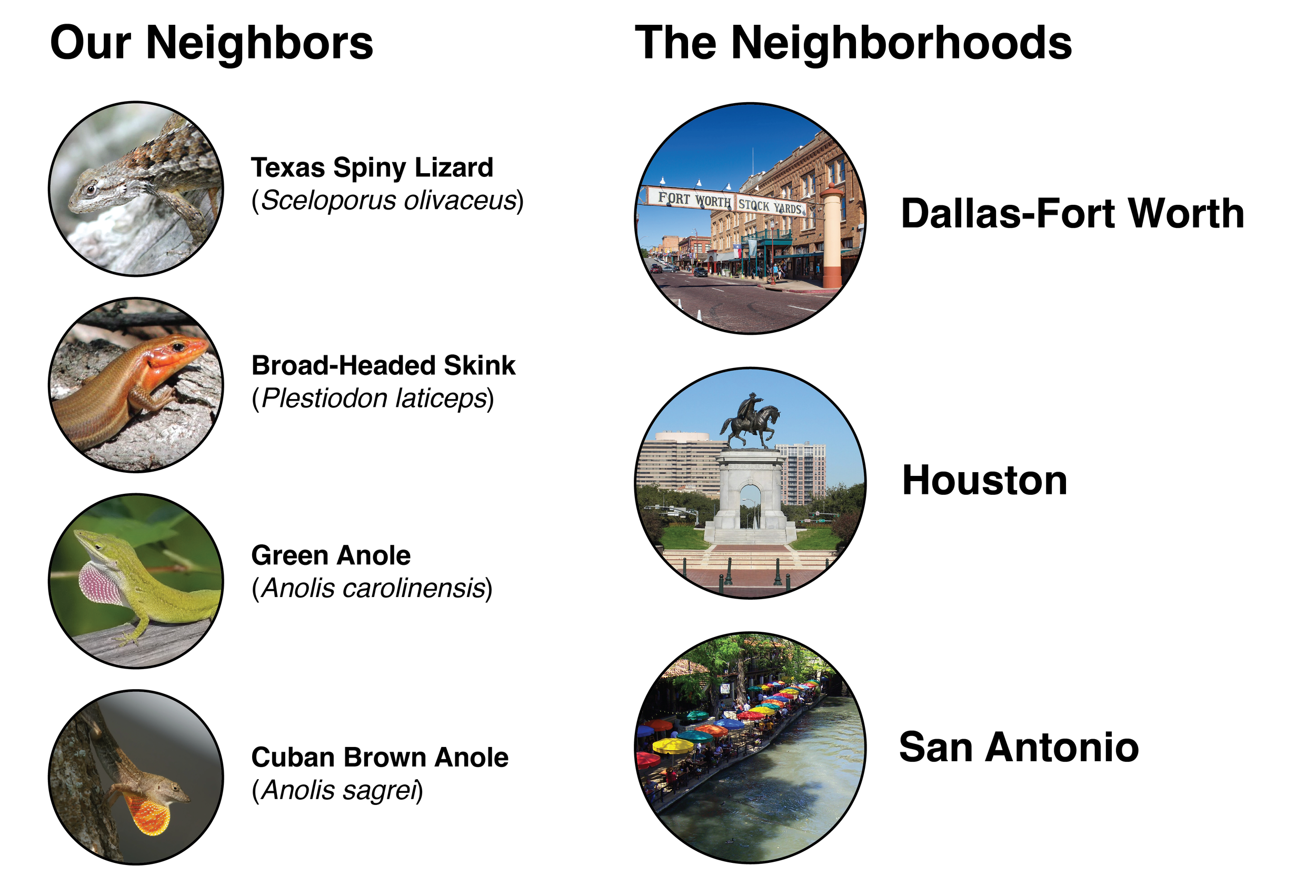
Cities are growing all over the world and housing pressure continues to push development further into wildlands. This growth produces risks and opportunities for both humans and wildlife. A major ongoing effort in the lab is focused on understanding the impact of urban landscapes on wildlife. Specifically, this project is aimed at understanding urban-tolerant lizards are capable of surviving in Texas cities using morphological, genomic, and epigenetic approaches. By comparing across four species and three different metropolitan areas in East Texas, we will gain insight into which features of our city environment facilitate and inhibit wildlife persistence. This research is aimed at building our understanding of foundational ecological and evolutionary questions as well as providing data that may be used for sustainable urban development and wildlife conservation.
Are you interested in understanding more about the lizards we share our cities with? If so, there are plenty of opportunities to get involved!
How you can contribute
Want to contribute to ongoing research? There are several way you can help the Texas Urban Lizard Project. We are interesting in occurrence data for lizards throughout the Dallas-Fort Worth, Houston, and San Antonio. regions. If you see a lizard, we encourage you to submit your observation to iNaturalist a repository for community science data. You can also contribute by providing salvage lizards or allowing sampling on your land.
-
You probably encounter lizards everyday in your backyards or walking around the city. These species are incredibly urban tolerant and can be found in neighborhoods and parks with sufficient vegetation. Knowing where these lizards are living is vital to our project. An easy way to get involved is to record your observations on iNaturalist, a wonderful community science driven website. Members of the community will verify your observations which allows them to be elevated to ‘research-grade’. This will not only help researchers, but is also a fun activity to do yourself or with friends and family!
-
Unfortunately, animals are die everyday in cities whether from cats, cars, or natural causes. If you come across a deceased lizard in your neighborhood, it may still contribute to science. We can accept salvage animals which are reasonably intact as they can still provide valuable morphological and genetic data to the project. Freezing is the best option to preserve salvage. Please fill out a salvage card including the species, location, and time. This information is necessary for the sample to have scientific value.
-
Sampling in urban landscapes is limited due to access to private property. If you would like to help by allowing researchers access to your property to collect data for this project, please reach out to discuss a suitable arrangement. We are happy to show you how to find and observe lizards or otherwise share our expertise with you.
-
A major goal of this project is to get the community involved and to spread appreciation for our urban wildlife. Thus, we are happy to discuss the possibility of conducting classroom or other community visits including lectures, guest lessons, and hands-on lizard spotting activities. Get in touch!